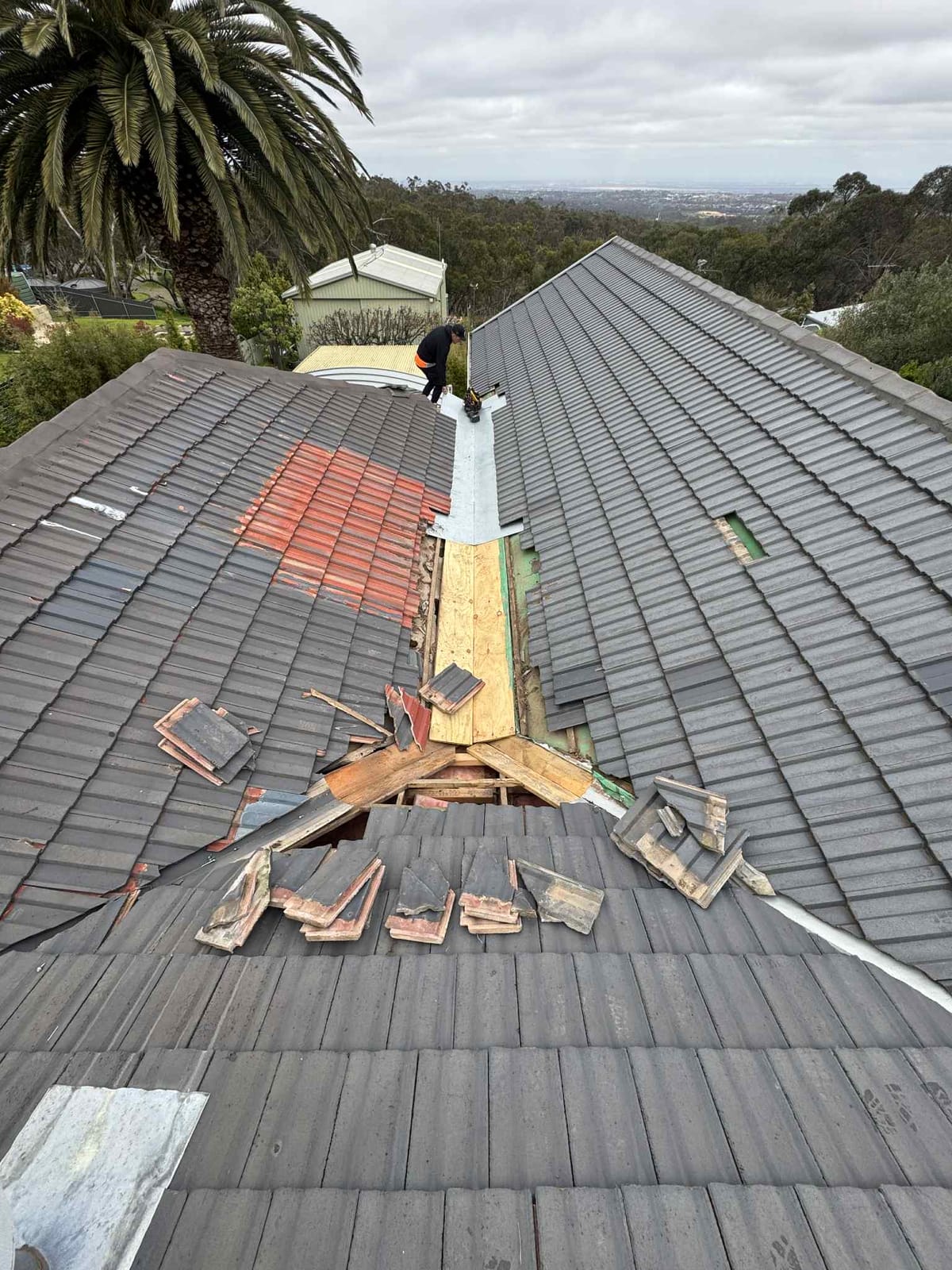
Rebedding and repointing is the repair that re-secures the ridge and hip capping on a tile roof. Rebedding means lifting the capping tiles, cleaning off the old mortar and laying them again on fresh bedding. Repointing is the finishing layer over that bedding that seals the joint and holds the caps in place, usually done today with a flexible pointing compound. If the mortar along your ridge capping is cracked, crumbling or missing, you need one or both, because that gap is where wind-driven rain, dust and pests get into the roof.
It is one of the most common jobs on Adelaide tile roofs, and it does not always mean a full roof restoration. When the tiles themselves are in good shape, the capping can be rebedded and repointed on its own.
Based in Redwood Park, we rebed and repoint tile roofs in Tea Tree Gully, Modbury, Golden Grove and Salisbury, and right across greater Adelaide.
What is the difference between rebedding and repointing?
The ridge capping is the row of curved tiles that covers the peak of the roof (the ridge) and the sloping corners (the hips). Traditionally those caps sit on a bed of sand and cement mortar, and a thinner layer of pointing is applied over the top to seal the edge.
- Repointing only suits a roof where the bedding underneath is still solid and the caps are firmly in place, but the outer pointing has cracked or weathered away. The old pointing is cleaned back and a new layer is applied.
- Rebedding and repointing is needed when the bedding itself has failed. The caps move when you push them, mortar has broken away underneath, or caps have shifted out of line. The caps are lifted, the old bedding is removed, the caps are re-laid on fresh bedding and then repointed.
Tile installation in Australia, including bedding and pointing, is covered by the Australian Standard AS 2050, Installation of roof tiles. That is the benchmark a properly done job should be measured against.
Why ridge capping mortar fails
Old-style sand and cement pointing is rigid. A roof is not. It heats up and cools down every day, expands and contracts, and moves slightly in the wind. Over years that movement cracks rigid mortar, and once it cracks, water gets in behind it and the breakdown speeds up. Adelaide's hot summers and cool winter nights give a roof plenty of that movement. Trees rubbing on the roof, foot traffic from other trades and the occasional storm all add to it.
That is why we use a flexible pointing that moves with the roof rather than cracking, as we explain on our roof restoration and repointing page.
Signs your ridge capping needs attention
You can spot most of these from the ground or a window, without going on the roof:
- Cracks or gaps along the mortar lines of the ridge and hips
- Pieces of mortar in the gutters, on paths or in garden beds below the roof edge
- Ridge caps that look uneven, wavy or out of line compared with the rest
- A ceiling stain or drip that lines up roughly with the ridge or a hip
- Birds going in and out under the capping, or nesting noise in the roof space
- Daylight visible along the ridge line if you look up from inside the roof space
If you are seeing a stain inside, our guide to why roofs leak covers the other common culprits, because the ridge is not always the cause.
What the job involves
- Inspection. We walk the roof, check how firm each section of capping is, and look at the tiles, valleys and flashings around it so we are not fixing one fault and leaving another.
- Lifting and cleaning. Where rebedding is needed, the caps are lifted and the old, failed mortar is removed.
- Rebedding. The caps are re-laid on fresh bedding, set straight and evenly spaced.
- Pointing. A flexible pointing compound is applied over the bedding to seal the joints.
- Broken tiles. Cracked or broken tiles found along the way are replaced as part of the job.
What affects the cost of rebedding and repointing
Every roof is quoted individually, and these are the things that move the price:
- How many metres of capping there are. A simple gable roof has one ridge. A hip roof has a ridge plus four or more hips, so there is far more capping to do.
- Repoint only, or rebed and repoint. Rebedding is more labour than repointing over sound bedding.
- Broken caps. Damaged ridge caps need replacing, and older or discontinued colours can be harder to match.
- Height, pitch and access. Two-storey homes and steep roofs need more setup and safety equipment.
- Whether it is part of a restoration. If the roof also needs cleaning and re-coating, doing everything in one visit avoids paying for setup twice.
For a rough idea, the independent cost guide What's The Damage? lists ridge capping rebedding and repointing for a full roof in Adelaide at $735 to $3,225, and a full tiled roof restoration at $3,675 to $10,100 (Adelaide roofing cost guide, updated October 2026). Nationally, Canstar puts a full roof restoration at from around $2,500 to $20,000 and beyond (Canstar, updated 15 January 2025). These are published third-party ranges, not our prices. The quickest way to know what your roof needs is a photo or an inspection.
Repointing on its own, or a full restoration?
If the tiles are sound and only the capping is failing, rebedding and repointing on its own is often all a roof needs. If the tiles are also faded, porous or covered in moss and lichen, it can make sense to do the capping as part of a full restoration: a clean, the capping work, broken tiles replaced and a protective re-coat. If the roof is failing across its whole area, it may be time to talk about replacement instead. Our guide to roof restoration vs re-roofing walks through that decision.
Either way, Sam will tell you what your roof actually needs, even when that is the smaller job.
Frequently asked questions
Is ridge capping the same as repointing?
Not quite. Ridge capping is the row of capping tiles along the ridge and hips of a tile roof. Repointing is the sealing layer applied to the joints of that capping. People often use the terms together because repointing is the most common repair done to ridge capping.
Do metal roofs need repointing?
No. Metal roofs, such as Colorbond steel, use metal ridge capping fixed with screws rather than mortar, so there is nothing to repoint. They need their fixings, flashings and capping checked instead.
How do I know if I need rebedding or just repointing?
If the capping tiles are firm and only the outer pointing is cracked, repointing may be enough. If caps move when pressed, have shifted out of line, or mortar has broken away underneath, they need rebedding as well. This is checked on the roof during the inspection.
Is flexible pointing better than sand and cement?
Old-style sand and cement pointing is rigid, and a roof moves as it heats and cools, so rigid mortar cracks over time. Flexible pointing compound moves with the roof instead, which is why we use it on rebedding and repointing jobs.
Can I repoint my own roof?
We do not recommend it. Working on a pitched tile roof is genuinely dangerous, tiles crack easily under foot, and poorly bedded caps can come loose in the next strong wind. A roofer will also spot other faults while up there.
Related services
Want Sam to take a look?
Send a photo through the quote form for an honest assessment and a free, no-obligation quote, or call Sam directly.